
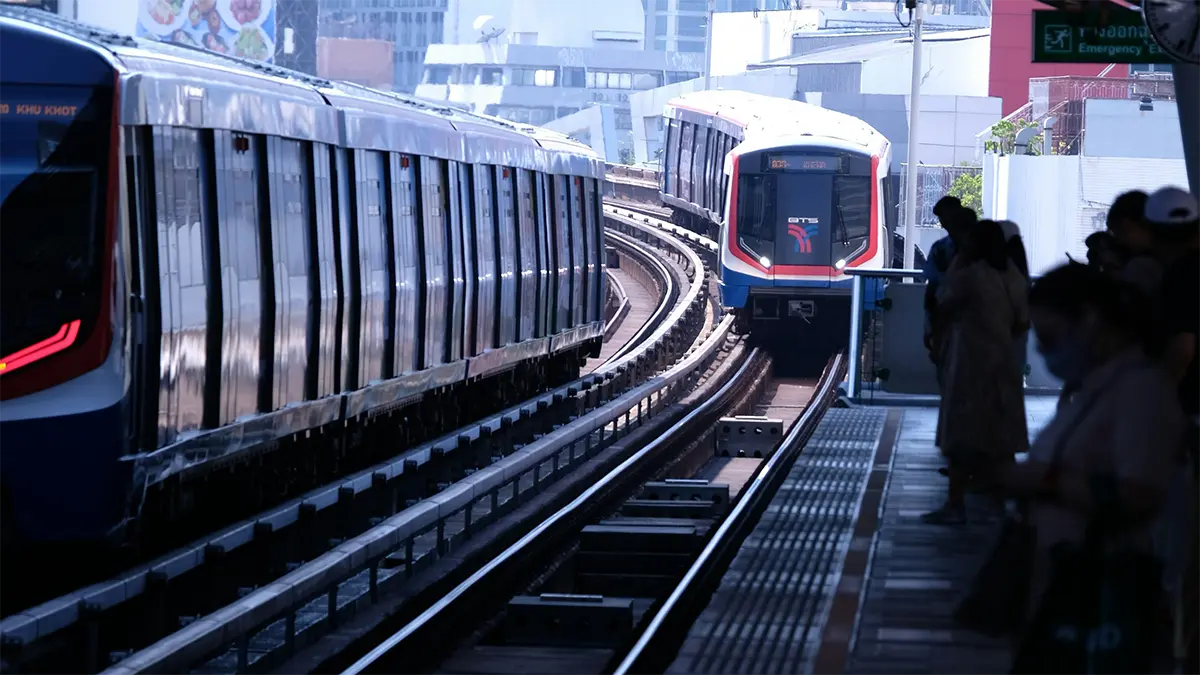
Thailand is easy to cross only when the route is built around the right gateways. A flight can look quick until airport transfers and baggage are added. A night train can save a hotel night without providing hotel-quality sleep. A ferry ticket can begin with a minivan and end several kilometres from the accommodation.
The best way to travel around Thailand therefore changes with the journey. Trains suit some northern and southern corridors. Flights protect time on a north-to-south trip. Buses and minivans fill the gaps. Ferries reach the islands, but weather, piers and land transfers still shape the day.
This guide compares the complete journey rather than the advertised vehicle time. It also shows how to travel without renting a scooter, how to choose one southern coast and where a little extra transfer budget can prevent an exhausting route.
Table of contentsJump to a section
Quick Answer: The Best Ways to Get Around Thailand
For most first trips, use urban rail and taxis in Bangkok, a train or flight between Bangkok and Chiang Mai, one domestic flight for a major north-to-south move, road transfers within the chosen southern region and ferries only for the islands you are actually visiting.
Start by comparing flights
A flight often protects a usable day, especially when Chiang Mai and a southern coast share a short itinerary. Count both airport transfers and baggage time before deciding.
Flight for time, sleeper for experience
Fly when the schedule is tight. Choose the sleeper train when the rail journey matters and a less predictable night of sleep will not damage the next day.
Bus, minivan or shared transfer
Road transport is often the practical link to Pai, Khao Sok, Krabi, Phuket and island piers. Luggage, pickup windows and motion sensitivity can change the best choice.
Confirm the complete ferry chain
Check the mainland gateway, exact pier, boat, arrival pier and final accommodation transfer. A joint ticket can coordinate several legs, but it may also include waiting.
Choose the base before the vehicle
Central accommodation can remove repeated taxi journeys. This matters in Chiang Mai and Ao Nang, and even more on larger islands with limited public transport.
Entirely practical with planning
Stay near useful transport, budget for taxis or shared pickups and avoid remote accommodation that assumes every guest drives.
How Thailand’s Transport System Actually Works
Thailand has extensive transport, but it is not one fully integrated network. Airlines, trains, buses, minivans, ferries and local taxis may use separate booking systems and separate terminals. A reseller can combine some legs, but the booking still needs to identify who operates each part.
Gateways matter more than destination names
Bangkok is the main national hub, yet Suvarnabhumi Airport (BKK), Don Mueang Airport (DMK), long-distance railway stations and bus terminals are not interchangeable. In the south, “Surat Thani” can refer to the city, airport, railway station in Phun Phin or a pickup point for the road journey to a ferry pier.
Krabi and Phuket are useful Andaman gateways, but neither is directly reached by Thailand’s main passenger railway. Koh Samui has an airport and multiple pier areas. A marker on a transport map is therefore a place where a journey changes mode, not necessarily where the traveler sleeps.
Not every marker belongs in one itinerary. Use only the gateways required by the route you have chosen.
One transfer can consume most of a day
Door-to-door time includes checkout, travel to the terminal, waiting, baggage, the advertised journey, onward transport and another check-in. Fatigue also matters. A cheap overnight journey followed by an early tour can cost more useful time than a daytime transfer and a normal night’s sleep.
Choose one southern coast
The Andaman side includes Phuket, Krabi, Railay, Koh Phi Phi and Koh Lanta. The Gulf side includes Koh Samui, Koh Phangan and Koh Tao, often reached through a different set of airports, road transfers and piers. Crossing between both coasts can work on a longer trip, but it is usually poor transport design in seven or ten days.
These maps explain transport logic rather than exact tracks, roads, flight paths or ferry routes. Lines are schematic, and they do not prove a direct or daily service.

Best Transport by Journey Type
There is no universal best mode. Start with the route and the full day it requires.
Domestic flight
Best when it removes a full overland day. Reconsider when airport travel, baggage and a connection erase the apparent advantage.
Day or sleeper train
Best for Bangkok–Ayutthaya, Bangkok–Chiang Mai and journeys toward the southern railway corridor. Reconsider when reliable sleep or a direct arrival matters more.
Intercity bus
Useful where rail is indirect or absent. Check the operator, vehicle, terminal and arrival time rather than relying on a broad “VIP” label.
Minivan or shared transfer
Practical for routes such as Chiang Mai–Pai and links around Khao Sok. Large luggage or motion sickness may justify a larger vehicle or private transfer.
Ferry or joint ticket
Choose after confirming weather exposure, piers and land transfers. The simplest ticket is not always the shortest day.
Rail, boat, taxi or local pickup
Bangkok has the strongest public network. On islands, accommodation location often matters more than finding one ideal local transport service.
Domestic Flights in Thailand
When flying is worth the cost and airport time
Flights are usually the first option to compare when crossing between northern and southern Thailand, reaching a far southern gateway on a short trip or avoiding backtracking through Bangkok. They can also be easier for families and travelers carrying luggage, provided the baggage allowance and final airport transfer are included in the comparison.
Main airport gateways
BKK and DMK serve Bangkok but sit in different parts of the city. Chiang Mai and Chiang Rai serve different northern routes. Krabi and Phuket are competing Andaman gateways, while Surat Thani and Koh Samui support different Gulf journeys. The cheapest arrival airport is not automatically the cheapest route once road and ferry legs are added.
Flight time versus total travel time
Compare hotel door to hotel door. A short flight still requires an airport journey, check-in, security, baggage collection and another transfer. An open-jaw plan can be efficient: arrive through one gateway and leave through another instead of returning over the same ground.
Baggage and changing airports
Low headline fares can change after checked luggage, seat selection, booking changes and airport transport are added. Policies differ by carrier and fare, so compare the final checkout rather than one search result.
Train Travel in Thailand
When trains work well
Trains make sense on routes where the railway itself is useful: Bangkok to Ayutthaya, Bangkok to Chiang Mai, and the southern corridor toward Hua Hin or Surat Thani railway station. They also suit slower itineraries and travelers who prefer more sitting space than a minivan offers. Check the current Bangkok departure station and the onward transfer at the destination.
Ayutthaya is a practical short rail journey. Phitsanulok can act as a rail gateway for an onward trip to Sukhothai. Surat Thani railway station is in Phun Phin, separate from Surat Thani city, the airport and ferry gateways. The map is not a timetable, and current station use, sleeper availability and booking rules need confirmation.
Day trains and sleeper trains
Day trains let you see the route and arrive without sacrificing a night’s sleep, but a long daytime journey may consume most of a sightseeing day. A sleeper can make the transfer feel like part of the trip.
A sleeper train replaces a hotel bed on the calendar. It does not guarantee the same rest. Noise, movement, berth choice, delays and an early arrival can affect the next day. Keep the first morning flexible.
Classes, booking and when not to take the train
Carriage layout and comfort vary. Confirm whether the booking is seated or sleeping accommodation, the correct station, passenger details and the actual ticket confirmation. The official SRT ticketing service is the best reference point; intermediaries may be convenient but can use different change and refund processes.
Choose another mode when the itinerary is short, reliable sleep is essential, the destination needs several onward transfers or the rail experience is not important enough to justify the time.
Buses, Minivans and Shared Transfers
Intercity and overnight buses
Intercity buses are useful where rail is absent or indirect and can connect regional cities without returning to Bangkok. The tradeoff is operator variation: terminal, seat layout, stops and arrival point matter more than a broad class label.
“VIP,” first class and similar terms are not a universal standard. Inspect the operator and vehicle details where available. For overnight travel, ask whether a poor night of sleep will weaken the next day. A daytime bus can be the better-value choice when it avoids paying for recovery.
Early and late arrivals need a plan. A bus terminal may be outside the walkable center, and ride-hailing availability is not guaranteed everywhere. Arrange the first transfer or ask the accommodation what is realistic before departure.
Minivans and shared transfers
When minivans are practical
Minivans and shared transfers fill routes where rail does not: Chiang Mai to Pai, Phuket to Krabi, Krabi to Khao Sok, Khao Sok to southern gateways and hotel-to-pier transfers. They can reduce planning when pickup and drop-off are clearly stated.
Khao Sok is an overland destination, not a ferry stop. Phuket, Krabi and Surat Thani suit different onward routes. The right pickup may also depend on whether the accommodation is in town, near a park entrance or farther away.
Luggage, hotel pickup and private transfers
Minivan storage can be limited, and tight seating is difficult for motion-sensitive travelers. Hotel pickup is convenient but may add a broad collection window and vehicle changes. A terminal departure is less personal but can be clearer.
Consider a private transfer for families, groups sharing the cost, large luggage, an early flight, a complicated Khao Sok connection or a traveler who cannot comfortably use a minivan. Pay for clarity: confirm the vehicle, exact pickup, child-seat request and included drop-off.
Ferries and Island Transfers
A ferry booking should answer five questions: where the land transfer begins, which pier it uses, who operates the boat, where it arrives and how the traveler reaches the accommodation. Missing one of those details can turn a simple island day into several unplanned transfers.
Andaman coast gateways
Phuket and Krabi are separate airport and mainland gateways. Railay normally uses local boat access. Koh Phi Phi and Koh Lanta use different piers and seasonal service patterns, while Pak Bara belongs to a farther-south route used for some Koh Lipe journeys. Khao Sok connects by road.
On Phuket, the airport and main departure piers require a road transfer, and Rassada is a planning point for selected departures. Around Krabi, Klong Jilad, Ao Nang-area departures and Ao Nam Mao serve different journeys. Railay often uses local boats. Tonsai and Saladan are useful planning points for Phi Phi and Koh Lanta, but not every drawn connection operates directly or throughout the year.
Gulf gateways
Surat Thani Airport, Surat Thani city and Surat Thani railway station in Phun Phin are separate. Donsak is another mainland ferry area. Koh Samui has its own airport and several pier areas; Koh Phangan and Koh Tao have separate arrival points. A joint ticket may contain a bus, waiting period, ferry and another local transfer.
Joint tickets can coordinate the mainland sequence, but they may use wide pickup windows and do not always include the accommodation transfer. A late unprotected flight or train can also break the ferry connection.
Ferry patterns also vary around the islands. Nathon and the Bangrak or Big Buddha area on Koh Samui can serve different route roles. Thong Sala is the planning point shown for Koh Phangan, and Mae Haad for Koh Tao. Some journeys are direct; others connect through another island.
Ferry, speedboat and joint-ticket tradeoffs
More space, usually a steadier feel
Often easier with luggage, though the trip can take longer and the final pier still matters.
Potentially faster, more weather-exposed
Useful on selected routes, but motion, spray, boarding and baggage handling may be harder.
Simpler coordination, less flexibility
Can combine road and sea legs under one booking. Confirm all pickup points, waits and the final included transfer.
Weather and ferry-to-flight buffers
Rain does not automatically stop transport, but rough seas, visibility and road conditions can alter or cancel a chain. Check current weather and operator notices, especially before a fixed flight.
Getting Around Bangkok
BTS, MRT and Airport Rail Link
The BTS and MRT are the most predictable starting points for areas they serve. The Airport Rail Link connects Suvarnabhumi with central transfer points. Stay near a useful line when practical, but check the actual walk from the station rather than choosing a hotel from the neighborhood name alone.
Chao Phraya river boats
River services can connect sights and neighborhoods that are awkward by road. Identify the correct pier and service rather than treating every boat as interchangeable.
The river is also useful for reaching Wat Arun and nearby historic areas without relying entirely on road traffic. Short crossings and passenger services have different roles, so use the pier name and destination rather than the word ferry alone.
Taxis, app-based rides and local gaps
Taxis and app-based rides help with luggage, late arrivals and places outside rail coverage. Confirm the pickup point and displayed route. Tuk-tuks can suit a short agreed journey, while motorbike taxis are less suitable with substantial luggage. Coverage and availability vary outside major urban areas.
Confirm the meeting point before requesting a ride, especially at airports, stations and large hotels with several entrances.
For airport travel, choose from the transport available at the airport you actually use. BKK and DMK are not substitutes for one another.
Getting Around Chiang Mai
Central Chiang Mai is manageable without a scooter. The Old City is partly walkable, while songthaews, taxis, app-based rides, airport transfers and organized pickups cover longer journeys. Ask where a Doi Suthep trip or Pai minivan actually starts, because a booking office and departure point may differ.
A scooter can add flexibility around Chiang Mai, but it is not required for a successful first visit. Choosing central accommodation and using a tour pickup for a remote attraction is often simpler than building the whole stay around riding.
Getting Around Krabi, Phuket and the Islands
Compact base with boat connections
Arrange the airport transfer, then use walking, local transport and longtail boats for nearby journeys. Railay is a boat transfer, while Koh Lanta and Khao Sok need separate route planning.
Large island, road-distance decisions
The airport, Old Town and beach bases are spread out. Local buses and taxis help, but choosing the right base can save more time than repeatedly crossing the island.
Plan around the accommodation area
Shared transfers and local taxis can support a scooter-free stay, though remote beaches require more transport budget and advance pickup planning.
Airport and several pier areas
The island is large enough that the arrival point matters. Confirm whether the hotel transfer is included and choose a base that fits the trip.
Pier pickup matters
Event dates, diving logistics and remote accommodation can pressure transport. Ask the property or dive school about pickup before booking the room.
Road and ferry transfers are separate decisions. A sea route is not automatically faster, and Khao Sok should always be reached overland.
Hotel pickup can add waiting and vehicle changes. Confirm the current route and schedule, especially when connecting to a ferry or flight.
Can You Travel Around Thailand Without a Scooter?
Yes. The route becomes easier when accommodation is chosen partly for transport rather than only for the view.
Bangkok
BTS, MRT, boats, taxis and walking cover many first-time journeys.
Central Chiang Mai
Walking, songthaews, app-based rides and organized pickups work from a central base.
Ao Nang
Walking, local boats and transfers cover a focused coastal stay.
Phuket and Koh Samui
Use taxis, available local transport and a strategic base; repeated cross-island trips become expensive.
Koh Lanta
Local taxis and selected accommodation areas work, but remote stays need more planning.
Koh Phangan and Koh Tao
Pier taxis, walkable areas and accommodation or dive-school transfers can work; check before committing to a remote room.
Budget for local taxis, ask about pier and airport pickup and avoid assuming ride-hailing operates everywhere. A more central room can cost less overall than a remote bargain plus several transfers.
If You Are Considering a Scooter
Rent only when you are legally entitled to ride the relevant motorcycle, your documents are accepted, your insurance conditions are satisfied and you are genuinely experienced. Wear a suitable helmet and inspect the vehicle and rental terms. Mountain, island and wet roads can be unforgiving.
A shop agreeing to rent a scooter does not confirm that the rider is legally licensed or insured. Police checks, passport deposits and damage disputes are separate risks. Do not leave an important original document as collateral without understanding the consequences and available alternatives.
Rental Car or Private Driver
When a rental car may help
A car can suit a family carrying luggage, a longer rural stay or a deliberate northern road trip. The driver still needs valid documents and suitable insurance, and must be comfortable with left-side driving, unfamiliar roads, parking and tolls. A car is rarely useful for central Bangkok.
When a private driver is the better choice
A driver can simplify a regional day with several stops, a Khao Sok connection, an early flight or a group journey where the price is shared. Confirm the vehicle, route, waiting time, child-seat request and whether tolls or parking are included. A driver is a comfort choice, not a requirement for central city travel.
How to Book Thailand Transport
Direct official booking
Use the official railway ticketing service for trains and the operating airline for flights when practical. For ferries and buses, identify the actual operator before paying. Direct booking can make service information and changes clearer, though the interface may be less convenient.
Booking platforms and local sellers
An aggregator is an intermediary, not the train, airline, bus or ferry operator. It can make comparison and joint tickets easier, but support, change and refund rules may differ. Hotels, hostels and local agencies can be useful for simple regional transfers and pickups; request a written confirmation with the terminal, time window and included legs.
When advance booking matters
Prioritize fixed or busy dates
Booking windows and class availability can change. Confirm the correct station and berth type.
Prioritize inflexible routes
The fare, baggage cost, airport and schedule can change.
Prioritize holidays and high demand
The operator, vehicle and terminal need confirmation.
Prioritize busy or limited service
Weather, operator, season and pier can change the journey.
Prioritize special pickup or luggage needs
The vehicle and collection window may change.
Prioritize early departures and families
Confirm the vehicle, child-seat availability and exact destination.
Avoid rigid universal booking windows. Reserve earlier when the route cannot move; retain flexibility when weather controls the final decision.
Major Thailand Transport Routes
Start by identifying the correct gateway, then compare the full journey. A destination shown on the same map may still require a flight, train, bus, minivan, ferry and local transfer in separate bookings.
Use the national gateway map above for geographic context. The route cards below describe planning choices, not guaranteed direct or daily services.
Flight or sleeper train
Train for independence
Treat each as a deliberate detour
Flight plus a local road transfer
Samui flight or mainland chain
Flight is the practical starting point
Road transfer first
Joint road-and-sea transfer
Choose the next gateway first
Match Transport to Time and Travel Style
Fly the major gaps
Use urban rail and taxis locally, flights between distant regions and private or shared transfers for awkward connections. Best for short trips, families, larger luggage and limited energy. Airport time remains the main drawback.
Use trains and direct buses
Choose public transport, seated or sleeper rail and shared island connections. Best for flexible travelers with light luggage. Long days and poor sleep can erase some of the apparent saving.
Mix modes deliberately
Use Bangkok rail and taxis, one train experience if it matters, one north-to-south flight, shared regional transfers, one southern coast and a mainland departure buffer.
By trip length
By traveler and mobility needs
Protect the final transfer
Public transport and shared transfers control costs. Use established operators, keep valuables with you and avoid an isolated late arrival unless the next pickup is arranged.
Do not optimize only for fare
Sleeper trains, buses and hostel booking desks are useful, but repeated overnight journeys can consume the days the cheap tickets were meant to protect.
Compare seats with one vehicle
A private transfer can become reasonable when several fares, luggage and vehicle changes are involved. Confirm child-seat or accessibility requests rather than assuming they are included.
Inspect the boarding chain
Ask about steps, ferry ramps, station access, vehicle changes and assistance. A larger ferry or direct road transfer may be easier than the quickest advertised option.
Luggage Tips for Thailand Transport
Luggage changes the journey most on low-cost flights, minivans and island transfers. Check airline allowances before comparing fares. Use a bag you can lift over a ferry ramp or uneven pier, and waterproof essentials during boat journeys.
Keep passports, medication, electronics and valuables with you rather than in a bus hold. Carry what you need for an overnight train or bus. If arriving before check-in, confirm storage with the accommodation instead of assuming it exists.
Safety, Scams and Common Transport Problems
Most transport problems are easier to prevent when the booking is specific. Match every ticket to the exact airport, station, terminal or pier; confirm the operator, cancellation terms and included transfers; and agree on the fare arrangement before a taxi or tuk-tuk journey. This is not an assumption that every seller or driver is dishonest. It is a way to remove ambiguity before departure.
Keep your passport, medication, electronics and other essentials with you on overnight journeys. Arrange the final ride after a very early or late arrival, follow official weather and operator updates before traveling by boat, and reject a rental vehicle or helmet that appears unsuitable.
Eight mistakes that cause avoidable problems
Counting only the advertised journey time
Include airport transfers, check-in, baggage and the separate cross-city journey when changing between BKK and DMK.
Booking by city name alone
Confirm the exact airport, station, terminal, pier and operator. Labels such as “VIP” do not define one consistent standard.
Treating overnight travel as free accommodation
Sleep is not guaranteed on a train or bus. Keep the next morning light and avoid stacking overnight journeys.
Combining both southern coasts
A short trip loses useful time moving between transport networks. Choose the coast that fits the season and route.
Building a fragile island departure
Check current ferry service, weather and operator notices. Leave the island earlier before an important international flight.
Ignoring pickup and baggage conditions
Hotel pickup may not be included, while minivan space and airline baggage charges can change the practical price.
Assuming a local ride will always be available
Ride-hailing coverage varies. Arrange a realistic final transfer for remote, very early or late arrivals.
Renting on assumptions
Confirm legal entitlement, insurance, vehicle condition and deposit terms before handing over documents or taking the vehicle.
Recommended Booking Tools and Official Sources
Use official sources to verify the service, then use a comparison platform when it genuinely makes booking easier. Results, baggage rules, cancellation terms and pickup points can change.
State Railway of Thailand
Airports of Thailand
Official airport directory for current airport information.
Urban transport
Current warnings
Licence guidance
Thai government guidance for foreign drivers. Confirm that the entitlement covers the vehicle class and that insurance accepts it.
The tools below are optional. Use only the search that matches a real part of your route, then verify the final operator, pickup point, cancellation terms and any licence or insurance requirements before paying.
Affiliate booking tools: The tools below contain affiliate links. If you make an eligible booking through them, WeltFox earns a commission at no additional cost to you. Read our full affiliate disclosure.
Related Thailand Itineraries and Guides
FAQ
FAQs About Traveling Around Thailand
What is the best way to travel around Thailand?
Use a mix of transport: urban rail and taxis in Bangkok, trains or flights on major corridors, road transfers for regional gaps and ferries for islands. The best choice depends on door-to-door time, luggage, comfort and the next gateway.
Is it better to fly or take trains in Thailand?
Fly when a long regional jump would remove a useful day. Take the train when it follows the route directly and the journey itself matters. Compare airport time with station and onward-transfer time.
Is the Bangkok-to-Chiang Mai night train worth it?
It can be worthwhile for the experience and can replace a hotel night, but it does not guarantee good sleep. Keep the arrival morning flexible and book the correct berth and station.
How far ahead should I book Thailand transport?
Book earlier when the date, route or class is fixed, especially for sleeper trains, flights and high-demand journeys. Ferry, bus and minivan availability can also change, but there is no single booking window for every trip.
Can I travel around Thailand without renting a scooter?
Yes. Stay near useful transport, use Bangkok rail, taxis, songthaews, shared transfers and organized pickups, and avoid remote accommodation that assumes every guest rides.
Is app-based ride-hailing available everywhere in Thailand?
No. Coverage and vehicle availability vary by city, island and time. Ask the accommodation about local taxis or pickups before booking a remote stay or late arrival.
What is the easiest way to reach the Thai islands?
Choose the correct mainland or island gateway first, then compare a combined road-and-ferry ticket with separate bookings. Confirm the exact pier, each transfer and whether the final ride to the accommodation is included.
How much time should I leave between a ferry and a flight?
There is no universal safe minimum because routes and weather differ. For an important international flight, the robust choice is usually to leave the island the previous day.
Which Bangkok airport should I use?
Use the airport shown by the airline and route. BKK and DMK are separate, so include the correct city transfer and never assume an airport change is a protected connection.
Can I use public transport with a large suitcase?
Often yes, but low-cost airline allowances, minivan storage, ferry ramps and uneven piers can make a large case awkward. Confirm luggage rules and choose fewer vehicle changes.
Final Recommendation
Build the route around gateways, not isolated ticket prices. Use public transport in Bangkok, choose a train when the journey adds value, fly one major regional gap when time matters and keep island travel on one coast. Then protect the final flight with a mainland or Bangkok buffer.
The most practical Thailand transport plan is rarely the fastest vehicle on every leg. It is the one that leaves enough time and energy to enjoy the places between them.




Reader Notes
Share your thoughts
Have a question, update, or practical tip about How to Travel Around Thailand: Trains, Buses, Flights and Ferries? Share it with other readers. Every comment and reply is reviewed before publication.
✓Moderated conversation
Rate this guide
Ratings appear here when available.
Conversation
Reader comments
Replies appear below the original comment after review.
Reader comments will appear here after review.
Add a note
Join the conversation
Share a useful update, a focused question, or a correction. Do not post personal information.