
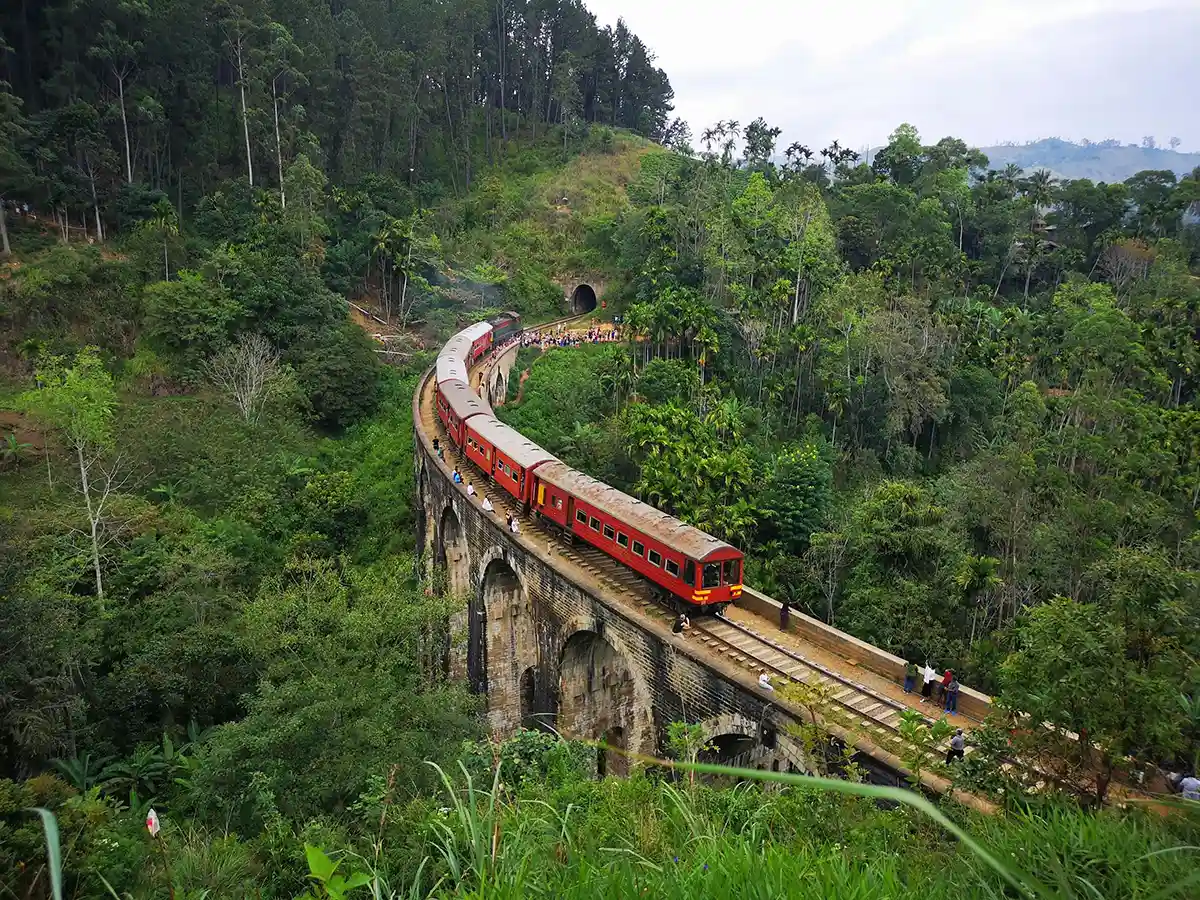
Sri Lanka looks compact on a map, but a short line between two towns can still become a substantial travel day. Mountain roads are slow, railway timetables do not cover every tourist route, and the last few kilometres often require a tuk-tuk or car.
The practical answer is not to choose one transport method for the whole trip. Use the train where the journey adds value, buses where time and luggage allow, local rides for short gaps, and a private transfer when several changes would consume the day.
This guide compares the complete journey, not only the time spent inside one vehicle. It is designed for first visits through Negombo or Colombo, the Cultural Triangle, Kandy, Ella, a safari base and one coast.
Table of contentsJump to a section
Quick Answer: The Best Way to Travel Around Sri Lanka
For most first trips, the balanced choice is a pre-arranged car for the awkward road legs, one scenic hill-country train, buses for straightforward budget journeys, and tuk-tuks or ride apps for local movement.
How Sri Lanka’s Transport Network Works
Sri Lanka has trains, buses and local vehicles across much of the island, but they do not form one integrated visitor network. A train reservation, an unreserved commuter ticket, a bus and a hotel pickup may all use separate systems. The journey can also finish at a different point from the town name shown on a booking page.
Gateways matter
Colombo Fort is the main rail hub for many visitor routes. Kandy and Nanu Oya shape the hill-country sequence, while Nanu Oya is the rail gateway for Nuwara Eliya. Sigiriya, Udawalawe, Yala and several beach areas usually need road transport for at least the final section.
Bandaranaike International Airport is near Katunayake, outside central Colombo and closer to Negombo. This is why a late arrival often works better with a simple Negombo night than an immediate cross-country transfer.
Count the complete day
Door-to-door time includes checkout, travel to the station or pickup point, waiting, the main journey, luggage handling, the final local ride and another check-in. A route that looks cheap can still be poor value if it removes the afternoon and leaves everyone too tired for the next morning.
Not every marked place belongs in one route
The north, east coast and south coast use different route shapes. A first trip rarely needs all three. Choose the region that fits the season and available days before booking the transport between isolated points.

Choose Transport by Journey Type
There is no universal best option. Start with the route, luggage and arrival time.
Private driver or transfer
Best when several public-transport changes, luggage or a fixed check-in would consume most of the day. Confirm the route, stops, vehicle and final price in writing.
Reserved train when available
Best when the railway journey is part of the experience. Keep a road alternative if a missed service would affect a safari, hotel or flight.
Bus
Useful for travelers with flexible days and manageable luggage. Reconsider when the journey needs several changes or finishes after dark.
Tuk-tuk, taxi or ride app
Good for stations, restaurants, viewpoints and nearby towns. Agree the fare before departure when there is no app or working meter.
Self-drive tuk-tuk
A specialist choice for confident travelers with extra time. Legal driving entitlement, permits, insurance, weather and vehicle condition need proper checks.
Walk, then use one local ride
Walking works within places such as Galle Fort or central Ella. It does not turn separated attractions or railway infrastructure into one continuous pedestrian route.
Trains and the Kandy-Ella Journey
Trains are memorable where the line fits the route. They are not automatically the fastest or easiest way to cross the island. Use rail for a journey that matters, then protect the fixed parts of the trip with a backup.
Reserved and unreserved travel are different
A reserved seat gives a specific place on a listed service. An unreserved ticket does not provide the same certainty and can be uncomfortable on a busy train, especially with a suitcase or children. Check the train, class, date and passenger details before payment rather than treating every rail ticket as interchangeable.
The official reservation portal and the Pravesha commuter-ticket system serve different ticketing needs. Pravesha states that commuter e-tickets are not valid on intercity trains. Use the service that matches the actual train rather than assuming one rail website covers every ticket.
Kandy, Nanu Oya and Ella
The classic sequence is Kandy - Nanu Oya - Ella. Nanu Oya is the railway station used for a road connection to Nuwara Eliya; adding Nuwara Eliya as an overnight stop is a separate itinerary decision.
Sri Lanka Railways reported that the Badulla-Nanu Oya section resumed after repairs on June 18, 2026. That dated notice is useful context, not a promise that every service or reserved seat will operate on your date. Check the current railway notice, timetable and reservation result again before building the day around it.
The separate Kandy to Ella train guide covers station choices, classes, luggage, active-railway safety and road alternatives in more detail.
Luggage and railway safety
Storage can be limited. Keep documents, medication and electronics with you, and use luggage you can move through a busy platform without blocking other passengers.
Railway lines around Ella remain active. Use formal crossings and currently verified public paths. Do not use the tracks as a walking trail or wait on them for photographs.
Buses in Sri Lanka
Buses reach many places that trains do not and are usually the lowest-cost way to travel. The tradeoff is less personal space, limited luggage room, uncertain arrival comfort and more effort when a route requires changes.
When a bus makes sense
Use buses for shorter regional hops, direct routes and flexible budget trips. They can work well between nearby south-coast towns and on corridors without a useful train, provided the boarding point and final stop are clear.
When to choose something else
A private or shared transfer is often calmer after a late flight, before a fixed safari, with young children, with motion sensitivity or with luggage that cannot be handled easily. The cheapest fare does not compensate for a missed connection or an exhausted arrival.
Online booking covers only part of the network
The national bus-ticket portal can be a useful starting point for supported services. It does not represent every local bus. Confirm important routes locally and avoid building a tight day around an online result that does not clearly identify the operator and boarding point.
Drivers, Tuk-Tuks and Ride Apps
Private drivers and transfers
A private car is most useful where it removes changes rather than simply replacing one direct bus. Airport to Sigiriya or Dambulla, the Cultural Triangle to Kandy, Ella to a safari base and the south coast to CMB are common examples.
Before confirming, ask for the route, pickup point, vehicle size, luggage capacity, included stops, tolls, parking, waiting terms, payment method and cancellation conditions. A low headline quote is not useful if the expected stops or final airport journey are excluded.
Protect a difficult day
Families, groups and short trips often gain the most when one vehicle replaces several changes and keeps the arrival predictable.
Do not hire a driver by default
A train experience, a simple coastal bus or a local tuk-tuk can still be the better choice. Use the car where it solves a real route problem.
Tuk-tuks for local journeys
Tuk-tuks suit short rides between accommodation, stations, restaurants and nearby attractions. Use an app or meter where available. Otherwise, agree the total fare before leaving and clarify whether waiting or a return trip is included.
PickMe, Uber and local availability
PickMe offers tuk-tuks, cars and larger vehicles through its app. Availability still varies by place and time. Ride apps are most useful in busier urban areas; a remote hotel, national-park area, very early pickup or late arrival needs a backup arranged with the accommodation.
Self-drive tuk-tuks are not the easy default
A rented tuk-tuk can suit a slow trip with light luggage and a traveler comfortable with unfamiliar traffic. Before accepting the vehicle, verify the licence and permit process, insurance coverage, breakdown support, deposit terms and what happens after an accident. Do not assume an ordinary car entitlement automatically covers the vehicle.
Airport Arrivals and Major Route Decisions
Negombo or Colombo after landing
Choose Negombo after a late arrival, before an early departure or when the priority is rest near the airport. Choose Colombo after an early arrival only when a deliberate city visit earns the extra transfer into the capital.
For Sigiriya or Dambulla, a pre-arranged road transfer is the simplest first-time choice. Public transport is possible, but it adds navigation and changes at the point when jet lag and luggage are least helpful.
Do not use departure day as a transport experiment
For an important international flight, favor a direct transfer or return to the airport region earlier. A coastal train or bus can be reasonable on a flexible day, but delays, traffic and the final airport connection need a generous margin.
Route-by-route starting points
The guide below compares useful defaults and cheaper alternatives. It deliberately avoids universal travel times: traffic, weather, service changes, stops and the exact pickup points can alter the day.
CMB Airport -> Negombo
- Practical choice
- Taxi, app ride or hotel transfer
- Budget alternative
- Bus only when the current route and timing are clear
- Why it works
- Keeps a late arrival simple and close to the airport.
- Watch for
- Do not add a long onward transfer after an overnight flight.
CMB Airport -> Colombo
- Practical choice
- Airport taxi, app ride or pre-arranged car
- Budget alternative
- Airport bus when the current service fits
- Why it works
- Works after an early arrival when the city visit is deliberate.
- Watch for
- Traffic and the final hotel transfer can lengthen the arrival.
CMB or Negombo -> Sigiriya or Dambulla
- Practical choice
- Private transfer
- Budget alternative
- Bus connections
- Why it works
- There is no useful direct train to the Cultural Triangle bases.
- Watch for
- Keep the arrival day light rather than adding major sightseeing.
Colombo -> Kandy
- Practical choice
- Train when the current schedule fits; road transfer when time matters
- Budget alternative
- Bus or unreserved rail
- Why it works
- Rail can add scenery without changing the route shape.
- Watch for
- Do not rely on an unconfirmed service for a tight connection.
Sigiriya or Dambulla -> Kandy
- Practical choice
- Private driver
- Budget alternative
- Bus
- Why it works
- A car simplifies luggage and any planned stop on the road.
- Watch for
- Agree the actual stops and reject unwanted sales detours.
Kandy -> Ella
- Practical choice
- Reserved train when the current service is suitable
- Budget alternative
- Bus or road alternative
- Why it works
- This is the main scenic railway experience on many first routes.
- Watch for
- Treat it as the main activity and keep a road backup.
Kandy -> Nanu Oya -> Ella
- Practical choice
- Train plus a local road connection if visiting Nuwara Eliya
- Budget alternative
- Bus connections
- Why it works
- Nanu Oya is the railway gateway for Nuwara Eliya.
- Watch for
- Nuwara Eliya is an itinerary substitution, not a free extra stop.
Ella -> Udawalawe or Yala base
- Practical choice
- Private or suitable shared road transfer
- Budget alternative
- Bus connections with a flexible arrival
- Why it works
- The safari branch is a road journey rather than a rail connection.
- Watch for
- Confirm the hotel, operator pickup and park entrance area.
Safari base -> Mirissa, Weligama or Galle
- Practical choice
- Road transfer
- Budget alternative
- Bus connections
- Why it works
- A direct vehicle protects recovery time after an early safari.
- Watch for
- Choose one coast base instead of changing hotel immediately.
Mirissa or Weligama -> Galle
- Practical choice
- Bus, train, taxi or tuk-tuk according to the exact bases
- Budget alternative
- Bus or train
- Why it works
- This is a comparatively simple coastal outing.
- Watch for
- Visit for the day rather than moving every piece of luggage.
Galle or south coast -> CMB Airport
- Practical choice
- Direct transfer when flight timing matters
- Budget alternative
- Train or expressway bus when the current service and margin fit
- Why it works
- A direct ride removes the final change before departure.
- Watch for
- Leave a generous buffer for traffic and disruption.
Colombo -> Galle or south coast
- Practical choice
- Expressway bus or private transfer for efficiency
- Budget alternative
- Coastal train
- Why it works
- Road and rail offer different balances of speed and scenery.
- Watch for
- Confirm the exact terminal, station and final local ride.
Cultural Triangle or Colombo -> Trincomalee
- Practical choice
- Current direct bus, train or road transfer according to the starting point
- Budget alternative
- Bus or train when the connection is practical
- Why it works
- This supports an east-coast route rather than a south-coast ending.
- Watch for
- Do not combine both coasts automatically on a short trip.
Ella or south coast -> Arugam Bay
- Practical choice
- Road transfer
- Budget alternative
- Bus connections with flexible timing
- Why it works
- The east-coast branch works best in a slower, season-led route.
- Watch for
- Do not squeeze it into a classic one-week south-coast itinerary.
Match Transport to the Trip
The 7-day route needs the most discipline because every slow connection removes sightseeing time. The 10-day itinerary supports a balanced mixed plan. The 14-day itinerary gives public transport more room without forcing it onto awkward safari or airport legs.
Budget travelers can complete much of the island with buses, trains and local tuk-tuks. Keep the bag manageable and accept that an arrival time is not the same as useful afternoon time. Families, older travelers and people with mobility limitations should ask about station access, steps, vehicle height, luggage handling and child-seat availability instead of assuming these are standardized.
Cost, Luggage and Common Mistakes
Transport prices move with distance, fuel, season, vehicle size, pickup time, booking channel and included stops. A durable budget compares categories rather than publishing a fixed fare that may already be wrong.
Local buses and unreserved rail
Best with flexible timing and light luggage. Crowding and the final local ride can change the practical value.
Tuk-tuks, taxis and app rides
Useful for short gaps. Compare the total fare, waiting and return journey before agreeing.
Private transfers
Groups can compare several separate fares with one vehicle. Check space rather than assuming every car fits all passengers and bags.
Lost time and recovery
An extra change, poor sleep or late arrival can remove the next activity. Include that cost when choosing the cheapest ticket.
Eight mistakes that make transport harder
Counting only vehicle time
Add checkout, station travel, waiting, luggage, the final ride and check-in.
Using one mode everywhere
A train, bus or driver is useful on particular routes, not automatically across the whole island.
Carrying more than you can move
Large cases are awkward on crowded buses, platforms and small tuk-tuks.
Trusting an undated timetable
Search the actual date and check current railway notices before fixing the next booking.
Accepting a vague driver quote
Confirm the route, vehicle, stops, tolls, waiting, luggage and final payable amount.
Assuming a ride app will appear
Arrange remote, very early and late pickups through the accommodation or a known operator.
Stacking a long transfer and activity
Keep the evening light after the hill train, safari transfer or cross-country bus.
Leaving the island crossing to flight day
Protect the international departure with a realistic road, rail and traffic buffer.
Keep documents, medication, electronics and valuables with you on public transport. Share important road-transfer details with someone you trust, use formal railway crossings, and reject a vehicle or helmet that appears unsuitable.
Booking Tools and Official Sources
Use official sources to confirm the service. Comparison tools are useful only after the route and dates make sense.
The tools below are optional. Aviasales compares flights into Colombo, while the activity search can help when an organized Cultural Triangle day removes awkward local transport. Verify baggage, pickup area, admissions, cancellation terms and the final provider before paying.
Affiliate booking tools: WeltFox may earn a commission from an eligible booking at no additional cost to you. Read the full affiliate disclosure.
Related Sri Lanka Guides
FAQ
Sri Lanka Transport FAQs
Short answers for choosing transport without making the itinerary more fragile.
What is the best way to travel around Sri Lanka?
Use a mixed plan: a private transfer for difficult road legs, a train where the rail journey adds value, buses for straightforward budget routes, and tuk-tuks, taxis or ride apps for local movement.
Do I need a private driver in Sri Lanka?
Not every day. A driver is most useful from the airport to the Cultural Triangle, between Sigiriya or Dambulla and Kandy, from Ella to a safari base, and for a time-sensitive airport return.
Can I travel around Sri Lanka only by train?
No practical first route is entirely rail-based because trains do not reach Sigiriya, the main safari bases or every beach directly. Combine rail with road transport and local rides.
Is the Kandy to Ella train operating?
Sri Lanka Railways reported the Badulla-Nanu Oya section reopened in June 2026, but operations, schedules and seats can change. Check the dated official notice, live timetable and reservation result for your journey.
How should I book Sri Lanka train tickets?
Use the official schedule and reservation services for the actual train. A reserved seat and a commuter or unreserved ticket are different products, so confirm the service, class, date and passenger details.
Are Sri Lanka buses practical with luggage?
They work best with a backpack or manageable bag. A large suitcase, several changes, motion sensitivity or a fixed arrival can make a transfer or train the more realistic choice.
Is PickMe available everywhere in Sri Lanka?
No. Ride availability varies by location and time. Keep an accommodation-arranged taxi or known local driver as a backup for remote, very early or late pickups.
Should I rent a self-drive tuk-tuk?
Only when the slow road trip is part of the plan and you are comfortable with local traffic. Verify driving entitlement, permits, insurance, vehicle condition, deposit terms and breakdown support first.
How do I travel from CMB airport to Sigiriya or Dambulla?
A pre-arranged road transfer is the simplest first-time option. Public transport is possible, but it adds changes and luggage handling after the flight.
How much time should I leave before an international flight?
There is no universal safe margin because traffic, starting point and transport mode differ. Avoid a fragile same-day chain and return to the airport region earlier when the flight is important.
Final Recommendation
Build the route first. Then give each journey the simplest transport that still protects the budget and the day.
For a typical first trip, that means a car from the airport toward the Cultural Triangle, road transport to Kandy, one hill-country train when current operations fit, another transfer to the chosen safari or coast, and local tuk-tuks, buses or app rides inside each base. Leave room for delays and a quiet evening after the longest moves.
The best Sri Lanka transport plan is not the one with the lowest fare on every leg. It is the one that reaches the right base with enough time and energy left to enjoy it.



Reader Notes
Share your thoughts
Have a question, update, or practical tip about How to Travel Around Sri Lanka: Trains, Buses and Drivers? Share it with other readers. Every comment and reply is reviewed before publication.
✓Moderated conversation
Rate this guide
Ratings appear here when available.
Conversation
Reader comments
Replies appear below the original comment after review.
Reader comments will appear here after review.
Add a note
Join the conversation
Share a useful update, a focused question, or a correction. Do not post personal information.