
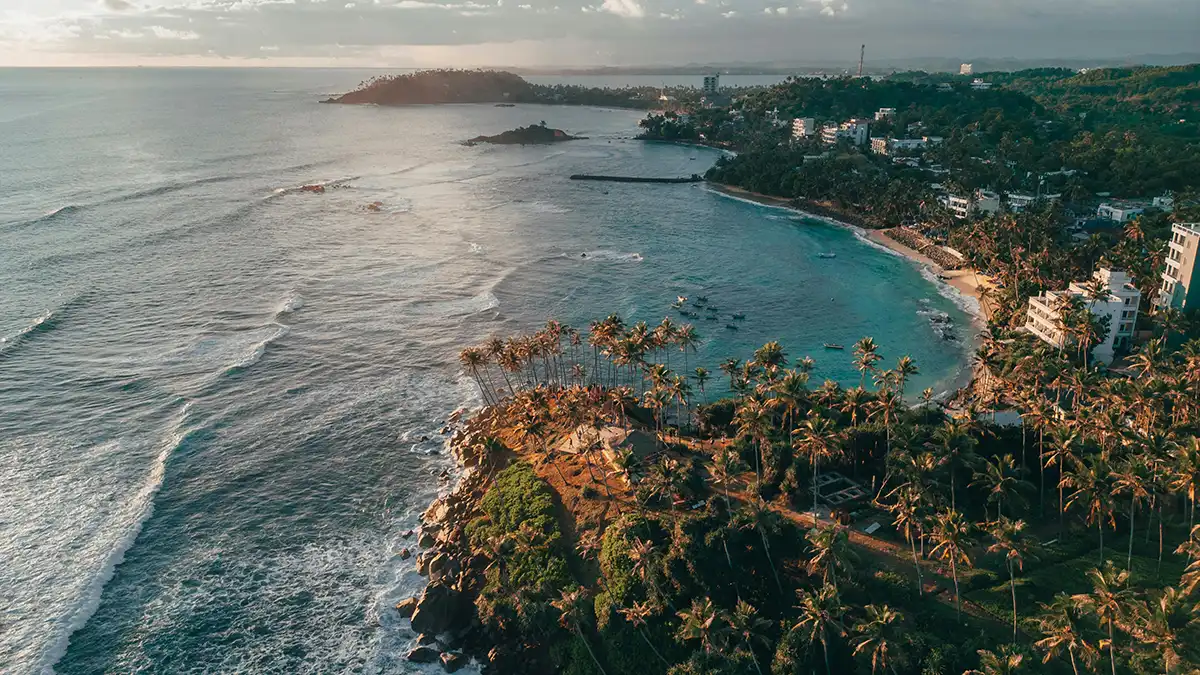
Mirissa is a small south-coast base with a broad beach, cafés, early whale-watching departures and easy connections to Weligama, Matara and Galle. It can be social without requiring a party schedule. It can also feel busy, spread along a noisy main road and surprisingly tiring if every beach stop becomes a separate excursion.
For most first-time visitors, two or three nights is enough. Choose Mirissa because you want a beach-focused pause, not because a whale sighting has been promised. Wildlife, sea conditions and departures remain uncertain, and a cancelled boat should not ruin the stay.
This guide helps you decide where to sleep, whether whale watching fits, what to combine, what to skip and how to leave enough room for weather and rest.
Table of contentsJump to a section
Quick Answer: Is Mirissa Worth Visiting?
Yes, Mirissa is worth visiting if you want a beach base with cafés, a social traveler scene and the option of a regulated whale-watching trip. It works particularly well at the end of a busy inland route, when another day of temples, trains and long transfers would be too much.
It is less suitable if your main goal is beginner surf every day, a walkable historic town or a very quiet coast. Weligama is usually the more practical surf base. Galle is stronger for history and streets you can explore on foot. Quieter beaches farther from Mirissa may suit travelers who want to disconnect rather than meet people.
Who Mirissa suits
Mirissa suits couples, solo travelers and backpackers who want a relaxed coast stop without giving up cafés, hostels or evening atmosphere. You do not need to join a party hostel to meet people. A small social guesthouse, surf lesson in Weligama or shared boat transfer can provide enough company.
It also works for travelers who want to do very little. A slow breakfast, a beach walk and an early night are valid plans after a long Sri Lanka route.
Who may prefer another base
Choose Weligama if beginner surf, more accommodation choice and easier everyday services matter most. Choose Galle if the fort, architecture, museums and a compact walking area matter more than staying beside a swimming beach. Choose Unawatuna if you want beach access close to Galle and accept a more developed resort strip.
In a short trip, choose one main south-coast base. Moving bags among Mirissa, Weligama, Unawatuna and Galle uses more time than the map suggests.
How Long To Stay and Where To Base Yourself
Two nights gives you one arrival afternoon, one full day and a departure morning. That is enough if Mirissa is a beach pause inside a fast itinerary.
Three nights is better when whale watching matters. It gives you a little room for a weather cancellation, seasickness recovery or a slow day. Four nights can work for remote workers, beginner surfers using nearby Weligama, or travelers who simply need rest.
Focused beach stop
Use the arrival day for the beach and one full day for whale watching or a land-based coastal plan. Avoid adding Galle, Weligama surf and every viewpoint.
Best balance for most visitors
Add weather flexibility, a Weligama or Galle outing, and enough unplanned time to recover from the inland route.
Slow coast base
Useful for surfing, work, repeated beach mornings or a trip where the coast is the main event rather than the final checkpoint.
Usually too rushed
A late arrival followed by an early boat and immediate transfer is tiring. Skip whale watching or stay longer instead of forcing both.
Where to stay in Mirissa
Stay near the central beach if easy sand access, restaurants and a social atmosphere matter. Check recent reviews for road noise, nightlife and uphill access; a place that looks close on a map may involve the busy A2 road or a steep lane.
The eastern side toward Coconut Tree Hill can feel calmer in places and suits early coastal walks. The harbor side is practical for some boat departures, but it is not automatically the best area for swimming or evening atmosphere.
Budget travelers should compare the total stay, not only the dorm price. Breakfast, drinking water, lockers, air conditioning, walkability and late check-in can change the real value. If sleep matters, do not book a party hostel simply because it is the first social option you see.
Whale Watching in Mirissa
Whale watching is optional. Mirissa can still be a good coast stop without it.
Sri Lanka Tourism identifies the waters off the south coast as a whale-watching area, and trips are commonly promoted during the calmer southern season, broadly around November to April. That is a planning window, not a sighting guarantee. Actual conditions vary by day and year.
Decide whether the trip suits you
A whale-watching morning can involve an early start, several hours offshore, sun, wind, spray and noticeable motion. Return time can move if animals are difficult to locate or sea conditions change. Do not place a fixed airport transfer, safari or prepaid afternoon tour immediately afterward.
If you are prone to motion sickness, discuss suitable prevention with a qualified medical professional or pharmacist before the trip. Do not wait until the boat is already moving to think about it.
How to choose an operator
The cheapest ticket is not automatically the best value. Ask direct questions before paying.
- Registration: ask for current vessel and operator registration or licensing details.
- Safety: confirm life jackets, passenger capacity, communication equipment, shade, toilets and the crew briefing.
- Wildlife conduct: ask how the crew responds when several boats find the same animals.
- Cancellation: understand what happens if the sea is unsuitable, the trip is shortened or no animals are seen.
- Pickup: confirm whether transport, harbor fees, food and hotel collection are actually included.
- Recent evidence: read current reviews for crowding, vessel condition, safety and responsible distances, not only sightings.
Sri Lanka’s sea-mammal regulations set operating conditions for observation vessels, including licensed operation, a registered guide, safety equipment, approach rules and restrictions during bad weather. A responsible crew should not chase, crowd, feed, touch or block marine mammals.
No operator can ethically guarantee a blue whale, a dolphin group or a close encounter. Treat certainty-heavy advertising as a warning sign.
Keep the afternoon light
After the boat, plan breakfast, a shower, rest and a quiet beach afternoon. Some travelers feel fine. Others need several hours before food, sun or another vehicle feels appealing.
If the trip is cancelled, do not search for a boat willing to ignore rough conditions. Use the morning for coffee, the beach, Weligama or a slow start instead.

Best Things To Do in Mirissa
The strongest Mirissa plan is short. Pick two or three things, then leave space for the coast.
Spend an unstructured morning on Mirissa Beach
Walk before the heat builds, have breakfast and choose a shaded place rather than filling the morning with transport. Swimming conditions can vary across the bay and from one day to the next. Look for local warnings and ask where conditions are currently suitable.
Visit Coconut Tree Hill carefully
Coconut Tree Hill is a recognizable coastal viewpoint, but it is not a private photo set. Go early for cooler conditions, stay away from unstable edges and respect any current access signs or land-use restrictions. If it is crowded, a shorter visit is enough.
Treat Parrot Rock as tide-dependent
Parrot Rock is close to the main beach, but the approach can become wet, slippery or impractical as conditions change. Do not cross because other people are doing it. Look at the water, follow local advice and skip it when the access does not feel sensible.
Use cafés as part of the day
Mirissa has enough cafés to make a slow morning easy. Beachfront places are convenient; smaller local restaurants away from the sand can be better for a budget meal. Recent opening hours and quality can change quickly, so choose by current reviews and what is actually busy rather than an old list of venue names.
Add one nearby outing
Weligama works for a surf lesson or a change of scene. Galle works for a history-focused day. Matara can be useful for transport and everyday services. Do not combine all three with whale watching in one day.
Secret Beach is optional, not essential. The name no longer means solitude, and access can involve rough lanes or steps. If your energy is low, the main beach is the better choice.
A Relaxed Two-Day Mirissa Itinerary
This plan assumes two full days or three nights. With only two nights, remove one branch.
Day 1: Arrive, settle in and use the beach
Leave time for the transfer. Arriving from Ella, Colombo or the Cultural Triangle can be more tiring than the route line looks.
After check-in, eat, rest and walk the main beach. Continue toward Coconut Tree Hill only if daylight, weather and energy allow. Have dinner near your accommodation rather than building the evening around another tuk-tuk trip.
Day 2: Whale watching or a land-based morning
If you booked a responsible operator and the sea is suitable, use the morning for whale watching. Keep the afternoon for breakfast, rest and the beach.
If you skip the boat, start slowly, visit the eastern coast and choose either Weligama or another nearby beach. This is not a failed version of Mirissa. For some travelers, it is the better day.
Optional Day 3: Choose one branch
Pick Galle for the fort and a walking day, Weligama for surfing, or another quiet Mirissa day. Do not use the extra day to move accommodation twice.
Short route: Mirissa Beach → eastern coast or Coconut Tree Hill → dinner near your base.
Wildlife route: early harbor transfer → whale-watching trip if conditions allow → rest and beach.
Extra-day route: choose Weligama or Galle, then return to the same accommodation.
How To Get To and Around Mirissa
Mirissa lies on Sri Lanka’s south coast between Weligama and Matara. The best transport depends on where the previous night was, how much luggage you carry and whether the journey is part of a longer route.
From Colombo, Galle or another coastal stop
The coastal railway and buses can be useful, but not every service stops where you expect. Search the current Sri Lanka Railways timetable for your exact date and stations. Weligama may also be a useful rail connection for some journeys, followed by a short local transfer.
A private transfer is simpler with several people, heavy bags or a late arrival. Confirm the vehicle, luggage space, pickup point and total price before leaving.
From Ella or the hill country
This is a road transfer rather than a simple extension of the hill-country train. Buses, shared transfers and private drivers are possible, but the journey can consume much of the day. Avoid planning a whale boat for the morning after a very late arrival.
Around Mirissa
Walk within one beach area, then use a tuk-tuk for separated beaches, the harbor or luggage. Agree the fare before a street pickup or use an app when service is available. Main-road traffic moves quickly, and pavements are inconsistent.
You do not need a scooter for a short stay. Rent only if your licence, insurance, experience and current local rules genuinely cover it. Convenience is not worth an uninsured crash.
Mirissa Budget Planning
Prices change by season, room type and demand, so a fixed daily figure becomes stale quickly. Build the budget around choices instead.
Compare the whole stay
A cheap bed far uphill or beside a loud road may add tuk-tuk costs and poor sleep. Check air conditioning, lockers, breakfast and walkability.
Mix cafés with local meals
Beachfront cafés are convenient but can cost more. Local rice-and-curry shops and bakeries help balance the budget.
Budget for safety, not only price
Compare the vessel, operator credentials, inclusions and cancellation terms. The lowest advertised rate may exclude important costs.
Group short rides
Walking one area at a time and combining errands reduces repeated tuk-tuk fares. Trains and buses can help between towns when the schedule fits.
Carry some cash for small restaurants and local transport, but avoid taking all of it to the beach. Confirm card fees and currency conversion before accepting a terminal’s exchange option.
Weather and When To Visit Mirissa
The south coast is commonly planned for the drier period around December to April, when sea conditions are often more suitable for beach and boat days. November and the edges of the season can work too. None of those months guarantees calm water or clear skies.
From roughly May into September, the southwest monsoon can bring more rain, wind and rougher sea conditions to this coast. Some businesses reduce operations. A sunny morning can still occur, but it should not be used as proof that an offshore trip is safe.
Check the Department of Meteorology’s marine forecast close to the trip. If traveling outside the usual south-coast window, consider whether the east coast fits the wider itinerary better rather than forcing both coasts into two weeks.
Safety and Responsible Travel
Mirissa is manageable for many first-time and solo travelers, but beach surroundings can create false confidence. Water, traffic and late-night transport deserve more attention than petty sales pressure.
- Swimming: check currents, swell, flags and local warnings each day; do not assume the whole bay has the same conditions.
- Boats: use a properly registered operator, wear the provided life jacket and follow the crew’s safety briefing.
- Wildlife: do not support chasing, crowding, feeding or touching marine animals.
- Roads: use lights after dark, avoid walking distracted beside the A2 and arrange a ride when the route feels exposed.
- Belongings: take only what you need to the sand and keep valuables secure in accommodation lockers or a safe.
- Solo nights: choose accommodation with recent reviews, share your return plan and use trusted transport after drinking.
Booking Tools and Official Sources
Book only after checking how the activity fits your route, the current forecast and the operator’s recent record. A responsible cancellation is better than a boat leaving in poor conditions.
Affiliate booking tool: The tool below contains affiliate links. If you make an eligible booking through it, WeltFox earns a commission at no additional cost to you. Read our full affiliate disclosure.
Useful official sources
Related Sri Lanka Guides
FAQ
Mirissa Travel FAQs
Short answers for choosing Mirissa and planning the coast without relying on a guaranteed boat trip.
Is Mirissa worth visiting?
Yes, if you want a beach-focused south-coast base with cafés, social accommodation and optional whale watching. Choose Weligama for a stronger beginner-surf focus or Galle for history and walkability.
How many days do you need in Mirissa?
Two nights works for a focused beach stop. Three nights is better when whale watching matters because it gives you room for weather changes, recovery and one nearby outing.
What is the best time for whale watching in Mirissa?
Trips are commonly planned during the calmer southern-coast period, broadly from November to April. Conditions and wildlife movement vary, so check the marine forecast and current operator information rather than treating the season as a guarantee.
Are whale sightings guaranteed in Mirissa?
No. Whales and dolphins are wild animals, and sightings, species and distance cannot be guaranteed responsibly.
How do you choose a whale-watching operator?
Check current registration, vessel condition, life jackets, passenger capacity, wildlife conduct, cancellation terms, pickup, included fees and recent reviews. Avoid operators that promise a specific animal or close encounter.
Is Mirissa good for solo travelers and backpackers?
It can be. There are social stays, cafés and nearby activities, but you do not need a party hostel. Check recent reviews for security, noise, location and late-night transport.
Should you stay in Mirissa or Weligama?
Choose Mirissa for a compact beach break, cafés and whale-watching access. Choose Weligama if beginner surfing, a longer stay and a broader everyday town base are more important.
Can you visit Galle from Mirissa?
Yes. Galle works as a separate outing by train, bus, taxi or driver when current transport fits. Keep enough time for the fort instead of combining it with whale watching and several beaches.
Do you need a scooter in Mirissa?
No. Walking, tuk-tuks and coastal transport are enough for most short stays. Rent only when your licence, insurance, experience and current local rules cover you.
Is Mirissa Beach always safe for swimming?
No beach is safe in every condition. Currents, swell and suitable swimming areas can change, so check local warnings each day and stay out when the water or access looks uncertain.
Final Thoughts: Plan Mirissa Around the Coast, Not a Checklist
Mirissa works best when it slows the trip down. Stay two or three nights, choose one nearby branch and leave the afternoon after any boat trip open.
Whale watching can be meaningful when the operator, vessel and conditions are right. It should not carry the whole stay. A calm beach morning, a local meal and enough sleep before the next transfer may be the more useful version of the coast.




Reader Notes
Share your thoughts
Have a question, update, or practical tip about Mirissa Travel Guide: Beaches, Whale Watching and a Slower Stay? Share it with other readers. Every comment and reply is reviewed before publication.
✓Moderated conversation
Rate this guide
Ratings appear here when available.
Conversation
Reader comments
Replies appear below the original comment after review.
Reader comments will appear here after review.
Add a note
Join the conversation
Share a useful update, a focused question, or a correction. Do not post personal information.