
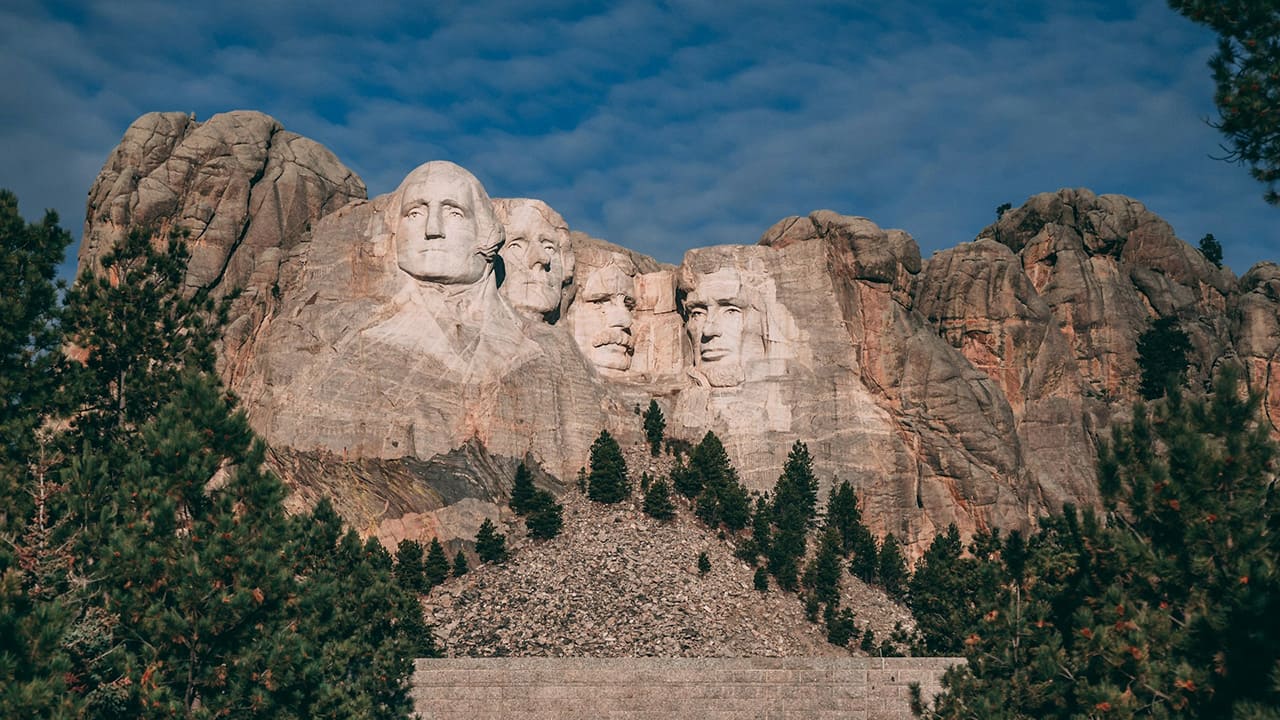
Mount Rushmore is a compact National Park Service site in South Dakota’s Black Hills. Most first visits need part of a day, not an entire day. The surrounding region needs separate time if you also want wildlife roads, caves, hikes, or another historical site.
The practical details matter. The memorial has no NPS entrance fee, but its concession-operated parking facility charges a fee. Trail sections differ sharply in accessibility, ranger and evening programs are seasonal, and mountain weather can change the day.
The history also needs more than a construction timeline. The carving presents a national story through four U.S. presidents, while the Black Hills remain a culturally and spiritually important Indigenous landscape with an unresolved treaty and land history.
Table of contentsJump to a section
Quick answer
Check the official NPS plan-your-visit page before departure. Alerts, weather, road conditions, trail access, and programs should override a general guide.
Is Mount Rushmore worth adding to your route?
Mount Rushmore makes most sense when you are already traveling through the Black Hills. It can add a focused stop about monument design, U.S. public memory, construction, and the contested history of the land. It also pairs naturally with one principal regional destination.
It is a weaker choice when reaching it requires a large detour for one photograph, when the group expects a major hiking destination, or when nobody wants to engage with the site’s historical context. Poor road or weather conditions are another sound reason to shorten or skip it.
Add it to a Black Hills route
Choose this when: you are already visiting Custer State Park, Rapid City, a cave, or another regional stop.
What it adds: a compact monument visit with construction, history, and public-memory interpretation.
Protect the rest of the trip
Choose this when: the memorial creates a major detour, the weather is poor, or the group wants trails rather than a monument stop.
Trade-off: a famous viewpoint is not worth losing a safer or more coherent regional day.
How long to spend at Mount Rushmore
Use time ranges as planning tools rather than promises:
- Short viewpoint visit: enough for Grand View Terrace and a quick orientation when the route is tight.
- Typical visit: roughly two to three hours for the terrace, visitor-center interpretation, and a suitable section of the Presidential Trail.
- Longer visit: useful when adding the Sculptor’s Studio, a ranger program, a meal, slower accessible movement, or evening lighting.
Parking queues, storms, summer visitor traffic, ice, and program schedules can all change the total. Avoid placing a fixed reservation immediately after the memorial.
What to do at Mount Rushmore
1. Begin at Grand View Terrace
See the principal view first. This gives the group the core experience before weather or energy changes and makes the rest of the site easier to understand.
2. Use the Lincoln Borglum Visitor Center
The exhibits explain the design, workers, carving methods, and intended presidential narrative. Read them before reducing the site to a photo stop.
3. Choose a suitable Presidential Trail section
The trail provides different angles and closer views, but the complete loop is not suitable for every visitor. The accessible portion and the stair-heavy portion are materially different.
4. Add the Sculptor’s Studio only when open
Seasonal access and security procedures can affect the studio. Check the current schedule rather than making it essential to a short visit.
5. Choose a program that adds useful context
The 2026 NPS summer schedule includes ranger and studio talks, Lakota, Nakota and Dakota cultural interpretation, hoop-dance storytelling, youth activities, and the evening program. Individual activities depend on the date, staffing, and weather, so check the current program calendar and choose one that genuinely improves the visit. Do not hold a wider Black Hills route for hours around an unconfirmed program.

Presidential Trail and accessibility
Only part of the Presidential Trail is wheelchair accessible. From Grand View Terrace, a surfaced route suitable for wheelchairs continues for approximately 0.2 miles toward viewpoints at the base of the mountain. Beyond that section, the loop includes approximately 422 stairs and is not accessible.
Visitors who do not take the stair section still have the main terrace, exhibits, and accessible viewpoints. The site also provides an accessible drop-off area, accessible parking, and elevators. Manual wheelchairs may be available without charge on a first-come basis.
Availability, closures, lift status, snow, ice, and individual suitability can change. Review the current NPS accessibility information and let each person choose a route that matches their mobility, heat tolerance, and confidence.
Parking, fees and reservations
The fee distinction is easy to miss:
- The National Park Service currently charges no entrance fee at Mount Rushmore.
- The concession-operated parking facility charges a separate parking fee.
- Federal recreation passes generally do not cover that concession parking charge.
- An ordinary visit, ranger program, and evening lighting program currently require no reservation.
- Parking for oversized vehicles and trailers is very limited.
- Overnight parking is not allowed.
Do not rely on an old parking amount from a blog or screenshot. Use the official fees page and parking guidance for the current charge, vehicle rules, and access arrangements.
Best time and daily timing
The NPS identifies June through August as the busiest period and currently suggests arriving before 9 a.m. or after 3:30 p.m. during those months. Treat those as planning guidance, not a crowd guarantee. Tour groups, weather, road incidents, and special events can change the pattern.
Morning usually gives you more onward flexibility. Late afternoon can work well when you want changing light or seasonal evening lighting, but it creates a later drive. Summer also brings heat and thunderstorms. Winter can bring snow, ice, reduced services, and difficult roads.
The evening program generally operates seasonally from late May into September, subject to current operations, staffing, and weather. Check the official ranger-program page for the date and start time of your visit.
History and Black Hills context
Mount Rushmore depicts George Washington, Thomas Jefferson, Theodore Roosevelt, and Abraham Lincoln. Gutzon Borglum directed construction from 1927 until his death in 1941, after which his son Lincoln Borglum oversaw the final work. The intended narrative connected the presidents with the founding, territorial expansion, development, and preservation of the United States.
That narrative sits within a much older and continuing Indigenous landscape. The Black Hills, known as Paha Sapa in Lakota, carry cultural and spiritual importance for Lakota people and other Tribal nations. The NPS currently identifies 21 associated Tribal nations with connections to the memorial landscape. These are living communities, not background to a completed historical story.
The 1868 Fort Laramie Treaty recognized the Black Hills within the Great Sioux Reservation and for the exclusive use of the Sioux. After gold was found and the United States failed to prevent incursions, the federal government confiscated the Black Hills in 1877. The land claim and the meaning of carving presidents into this mountain remain contested.
This context is not an optional counterpoint to the engineering story. It changes how the memorial should be understood. A responsible visit can examine the workers and technical process while also recognizing treaty violations, Indigenous sovereignty, and the limits of a presidential narrative presented as universal.
Read the NPS overview of associated Tribal nations and the National Archives history of the Fort Laramie Treaty before or after the visit.
What to combine nearby
The Black Hills and nearby plains contain more than one day’s worth of substantial places. Choose one principal companion stop for a short visit, or spread the region over two or more days.
Each place has separate access, weather, fees, and operating conditions. Open the official page before committing the route.
Custer State Park
Why choose it: scenic roads, wildlife viewing, lakes, and trails.
Trade-off: slow roads and wildlife require time; choose a focused park route rather than every loop.
Same day? Possible when the day stays focused and conditions cooperate.
Crazy Horse Memorial
Why choose it: a separately interpreted memorial and cultural complex.
Trade-off: it is privately operated with separate admission and its own schedule.
Same day? Often possible, but allow time to engage with the interpretation.
Wind Cave National Park
Why choose it: cave geology above a substantial prairie ecosystem.
Trade-off: tour availability and cave operations can change; the surface park still needs route time.
Same day? Possible only with a realistic reservation and driving buffer.
Jewel Cave National Monument
Why choose it: a cave-focused visit with different tour formats.
Trade-off: tour reservations, fitness limits, and current operations control the visit.
Same day? Possible when a confirmed tour anchors the schedule.
Badlands National Park
Why choose it: eroded formations, prairie, wildlife, and a very different landscape.
Trade-off: it is not a quick next-door stop; road time and heat need their own plan.
Same day? Usually better as a separate route day or a deliberate transit-day stop.
Rapid City
Why choose it: accommodation, food, services, and a useful base for regional day trips.
Trade-off: staying in town adds a drive to the memorial but can simplify a wider itinerary.
Same day? Yes, as a base, meal stop, or modest city addition.
One-day and two-day Black Hills planning
These are route shapes, not minute-by-minute schedules. Keep meal, parking, road, and weather buffers.
Mount Rushmore plus one principal stop
Shape: Mount Rushmore, then Custer State Park or Crazy Horse Memorial.
Protect: leave time for driving, a meal, wildlife delays, and changing weather.
Avoid: adding both caves, every scenic road, and Badlands to the same day.
Separate monument and landscape time
Day 1: Mount Rushmore with a focused Custer State Park route.
Day 2: choose Crazy Horse, one cave, Rapid City, or another regional priority.
Benefit: more room for weather, interpretation, and slower roads.
What to skip
- Skip the evening program when waiting would create a tired or unsafe onward drive.
- Skip the complete Presidential Trail when stairs, heat, ice, injury, or mobility make it a poor fit.
- Skip the assumption that a parking receipt is a federal park entrance pass.
- Skip trying to see every Black Hills attraction in one day.
- Skip treating Indigenous history as a detachable controversy box.
- Skip crossing the region only for a photograph when the detour overwhelms the trip.
Mount Rushmore with children and accessibility needs
The main terrace and exhibits can make a manageable family visit without requiring the full trail. The NPS also offers Junior Ranger material and seasonal programs, subject to current availability.
Check restroom and elevator status, weather, trail stairs, sensory needs, and the distance each person is comfortable covering. A shorter shared visit is better than forcing every member of the group through the same loop.
Guided Mount Rushmore and Black Hills tours
A guided day can help when nobody wants to drive or when the pickup location fits a regional route. The article remains complete without loading this optional comparison tool.
Confirm the exact pickup point, time at Mount Rushmore, other included stops, accessibility, admission and parking inclusions, meal plan, and cancellation terms. A listing described as a Black Hills tour may devote only a short time to the memorial.
Affiliate note: WeltFox may earn a commission from an eligible booking through this tool at no additional cost to you. The provider controls availability, prices, and booking terms.
Official Mount Rushmore planning links
Use official pages for the details most likely to change, and reopen the relevant link shortly before travel.
Mount Rushmore checklist
- Open current NPS alerts and the plan-your-visit page.
- Confirm the concession parking charge and vehicle limits.
- Review accessibility, elevators, and the suitable trail section.
- Check Black Hills road and weather conditions.
- Check the ranger and evening-program calendar.
- Carry water, sun protection, layers, and suitable footwear.
- Choose one realistic nearby priority.
- Leave a driving and meal buffer.
- Read the Indigenous and treaty context, not only the carving story.
FAQ
Mount Rushmore planning FAQ
Is Mount Rushmore free?
The National Park Service currently charges no entrance fee, but the concession-operated parking facility charges a separate fee. Federal recreation passes generally do not cover that parking charge, so check the current NPS fees page before travel.
How long should you spend at Mount Rushmore?
Roughly two to three hours works for many first visits that include the terrace, interpretation, and a suitable walk. A short viewpoint stop takes less; seasonal programs, the studio, meals, crowds, or accessibility needs can make the visit longer.
Do you need a reservation for Mount Rushmore?
An ordinary visit and the evening lighting program currently require no reservation. Separate tours and some nearby cave activities can have their own booking requirements.
Is the Presidential Trail accessible?
Only part of it. The NPS describes an accessible surfaced route from Grand View Terrace toward base viewpoints, while the remaining loop is not accessible and includes approximately 422 stairs. Check current closures and elevator status.
Is the Mount Rushmore evening lighting program year-round?
No. It generally operates seasonally and can be affected by weather, staffing, or other operations. Confirm the program calendar for the exact date rather than planning from an old schedule.
Why is Mount Rushmore contested?
The memorial was carved in the Black Hills, a culturally and spiritually important Indigenous landscape tied to the 1868 Fort Laramie Treaty and later U.S. confiscation. The presidential symbolism and the carving itself remain inseparable from ongoing questions of land, sovereignty, and public memory.
What can you combine with Mount Rushmore?
Custer State Park or Crazy Horse Memorial can work as one principal companion stop. Wind Cave, Jewel Cave, Badlands, and other regional places need their own access and driving calculations; do not assume they all fit one day.
Is Mount Rushmore suitable for children?
The main terrace, exhibits, and suitable Junior Ranger material can work well for many families. Weather, trail stairs, attention span, mobility, and current services should determine how much each child or adult does.
Final planning recommendation
Mount Rushmore works best as a focused stop inside a considered Black Hills route. See the monument, understand how it was made, and leave enough attention for the living landscape and history that the sculpture does not contain.
Allow roughly two to three hours for a typical first visit, choose only one principal regional companion stop for a one-day plan, and check parking, accessibility, programs, weather, and Highway 385 conditions before setting the final order.

Reader Notes
Share your thoughts
Have a question, update, or practical tip about Mount Rushmore Travel Guide: Visit Time, Parking and Black Hills Planning? Share it with other readers. Every comment and reply is reviewed before publication.
✓Moderated conversation
Rate this guide
Ratings appear here when available.
Conversation
Reader comments
Replies appear below the original comment after review.
Reader comments will appear here after review.
Add a note
Join the conversation
Share a useful update, a focused question, or a correction. Do not post personal information.